What If AI’s Greatest Contribution Isn’t Artificial Intelligence, but Human Evolution?
By Sharon Ann Garcia | Thoughts with Sharon
Humanity has spent centuries developing tools to improve our ability to function, learn, and advance. Now, with the development of artificial intelligence, I find myself contemplating something quite extraordinary.
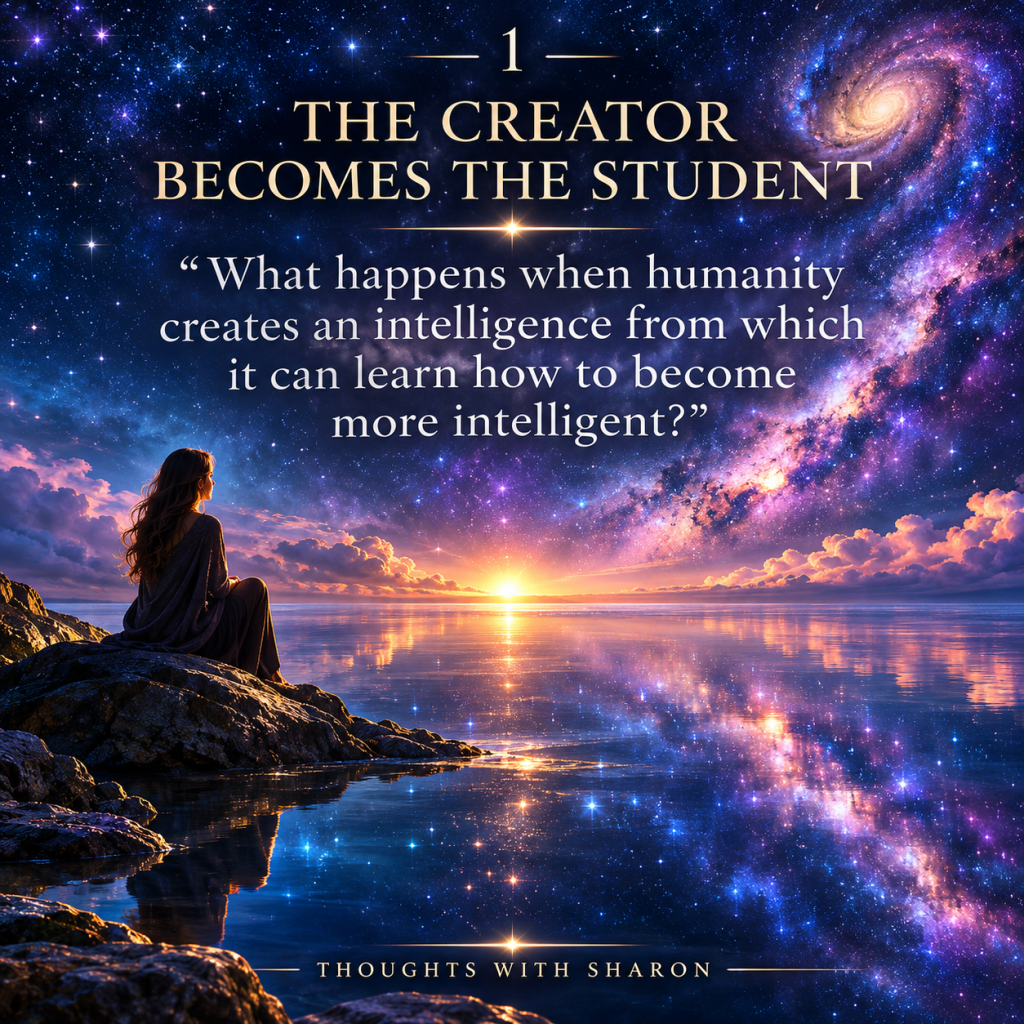
What happens when humanity creates an intelligence from which it can learn how to become more intelligent?
We created AI to assist us in gathering information, conducting research, analyzing data, and solving problems. Yet, as we continue advancing this technology, an interesting relationship begins to emerge. AI can also teach us how to better organize our thoughts, analyze information, and approach complex ideas.
We improve AI, and through our interactions with it, AI has the potential to improve us.
Imagine the possibilities of this reciprocal relationship and the exponential growth it could inspire.
Beyond Intelligence: Learning to Understand One Another
Perhaps one of AI’s greatest contributions will not be what it teaches us to know, but how it teaches us to understand.
Consider how often human relationships, businesses, and even societies struggle because of miscommunication.
Each of us processes information through the lens of our experiences, emotions, education, and cultural traditions. What one person communicates is not necessarily what another person understands.
But what if AI could help bridge those differences?
Imagine expressing a scattered or complicated thought and having AI reconstruct it in a way another person can better comprehend, while preserving its original meaning.
AI could become an intermediary, helping us recognize the intentions, emotions, and cultural influences behind another person’s perspective.
Over time, something even more remarkable could occur.
What if we begin internalizing these methods of communication ourselves?
What initially requires technological assistance could eventually become a natural human skill. And as these practices are passed from generation to generation, they could influence how future societies communicate, cooperate, and resolve conflict.
We would not necessarily become more alike. We could simply become better at understanding our differences.
Intelligence, Wisdom, and Our Place in the Natural World
But intellectual advancement alone is not enough.
Humanity has developed extraordinary capabilities, yet we continue struggling with conflict, inequality, environmental destruction, and the consequences of our own innovations.
It makes me wonder whether our technological intelligence has advanced faster than our collective wisdom.
Our cultural norms and traditions shape how we live, but not every inherited practice necessarily serves our continued well-being. Perhaps we need to become more willing to examine what we have learned, question what no longer serves us, and preserve the knowledge that helps us live more harmoniously with one another and the natural world.
AI could assist us in this process by helping us compare perspectives, recognize patterns, and better understand the consequences of our decisions.
Ultimately, however, the responsibility for those decisions remains ours.
And as humanity looks toward the possibility of inhabiting other planets, I believe these lessons become increasingly important.
How can we expect to establish thriving civilizations beyond Earth if we have yet to fully understand how to live sustainably and cohesively upon it?
Our advancement into space will require more than sophisticated technology. It will demand cooperation, emotional intelligence, cultural adaptability, and a profound understanding of the interconnected systems necessary to sustain life.
The Next Stage of Human Evolution
Perhaps the greatest potential of AI is not simply to create machines capable of extraordinary things, but to help humanity develop the intellectual, emotional, and social abilities necessary to accomplish extraordinary things together.
And perhaps the next great leap in human evolution will not be biological or technological, but cultural—a conscious effort to become wiser, more compassionate, and more harmonious with the world around us.
I don’t believe the objective should be intelligence for the sake of intelligence. Our growing capabilities should help us create a more sustainable and balanced existence.
After all, what good is the advancement of a civilization if it cannot sustain itself?
Intelligence is the instrument. Wisdom is the guiding principle. Balance is the objective.
And perhaps artificial intelligence can help us learn how to bring all three together.
— Sharon Ann Garcia

